





Show/Hide Description.
Julia Donaldson is a prolific author with over 200 books to her name, yet we all go “THE GRUFFALO!” when we think of her! Much of her published work is in picturebook form, but she’s also written the reading scheme, ‘Songbird Phonics’ (Oxford University Press), and when she was Children’s Laureate (2011 to 2013) she focused on reading and acting and published a series of short plays for schools and poems to perform. She’s worked with dozens of illustrators and her website is well worth browsing through as it’s kept fairly up to date and has lots of information to follow up https://www.juliadonaldson.co.uk/.
According to a Guardian article from 17 December 2020, a Julia Donaldson book is sold every 11 secs in the UK. She was the best-selling author of the decade (2010 – 2019) ‘in any age group or genre, according to the trade database Nielsen Bookscan’, selling more than 27 million books. WOW! https://tinyurl.com/yh3jayhj
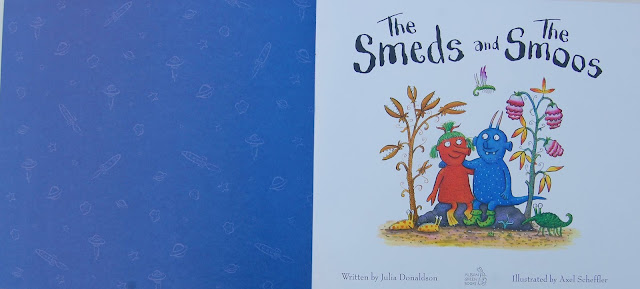
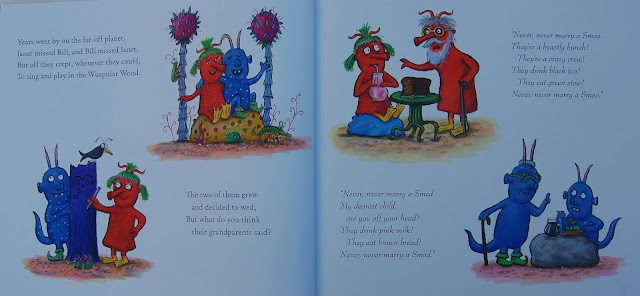
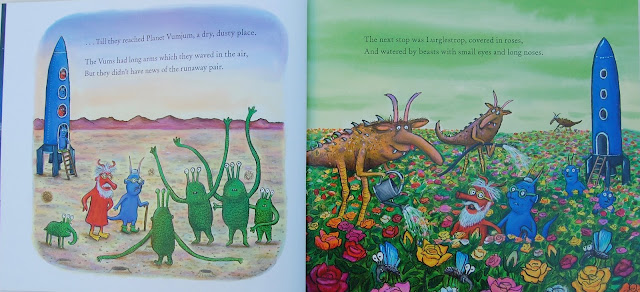
This month on PEPELT we have decided to share some of the other books that Julia Donaldson has written. I have chosen ‘The Smeds and the Smoos’, illustrated by Axel Scheffler and published by Alison Green Books (2019). It’s a sort of Romeo and Juliet story with a happy ending, no one dies, instead, everyone realises that just because we are different it doesn’t mean we can’t be together, play with each other, be friends … fall in love even. It’s written in rhyme, of course, and contains some hilarious made-up words for places and plants… ‘a lobular lake’, ‘a humplety hill’, ‘the Wurplar Wood’, ‘trockles’, ‘glompoms’ and ‘jerberrycoot’. ‘The Planet Vumjum’, ‘Planet Glurch’ and ‘Lurgleestorp’, ‘Grimbletosh’, ‘Scloop’ and ‘Klaboo’ … I think you’ll agree they are all wonderfully silly words, completely made up and just delicious to say.
You will all know by now that it’s not just the words that make a picturebook a GOOD PICTUREBOOK! It’s the pictures and the words together! The pictures in ‘The Smeds and the Smoos’ often expand on the rhyming words, with lots of opportunities for interpreting and meaning-making, often through humour, so it’s well worth looking carefully at Axel Scheffler’s characteristic illustrations alongside Donaldson’s rhyming verbal inventions.
I’ve written a blog about this picturebook where you can learn more about it. Just click on the link below!
‘The Smeds and the Smoos’ is an entertaining picturebook with a message, which is easy to share … it doesn’t matter how different we are, we can still get along. The dedication comes at the back and Axel Scheffler’s dedication says: ‘To all the children of Europe’. You can share this at the end of your read-aloud and ask the children why Scheffler has done this.
Children will enjoy the made-up words and might even try making more of their own. They can also learn the last rhyming verse and chant it as a playground game … maybe with a skipping rope, jumping on the beat.
Then they sang by the light of the silvery moon,
And you can sing too, if you make up a tune.
Play with the Smeds and play with the Smoos.
Play with whichever friends you choose.
Then close your eyes and while you snooze,
Dream of the Smeds and dream of the Smoos.


Show/Hide Description.
To continue our month on Julia Donaldson, I (Gail) have chosen ‘The Hospital Dog’ published by Macmillan Children’s Books in 2020 and illustrated by Sara Ogilvie who also illustrated ‘The Detective Dog’. ‘The Hospital Dog’ won the Indie Book Awards for best picturebook in 2021. In true Julia Donaldson style, it is written in rhyme with a repeating refrain.
On her website, Julia Donaldson explains she got the idea for the book when she was visiting a children’s hospital and saw a picture of their visiting dog on a notice board. She then found out that the dog Nala and her owner Sandy lived very near to her, so she persuaded them to take her on a ward round to get ideas for her story. She has changed their names in the story to Dot, a Dalmatian, and Rose but the book is dedicated to Nala and Sandy.
Each morning after their breakfast and a swim in the sea, Dot and Rose take a bus to the hospital to visit the children of Wallaby Ward who are always pleased to see them; from a crying baby to a bored teenager – a pat, a stroke, and a cuddle with Dot cheers everyone up.
‘A pat and a stroke and a cuddle with Dot.
Is Bea feeling scared still? NO, SHE’S NOT!’
Therapy dogs in a hospital help alleviate the situation and reduce anxiety for children who are away from home and may be under frightening and unpleasant circumstances. They provide comfort and entertainment and a positive distraction. The staff and parents also get a lot out of the visit as the children do, as we see in ‘The Hospital Dog’.
‘She calms down a doctor; she cheers up a mummy.
She lets little Tyler play Tickle Dot’s Tummy.’
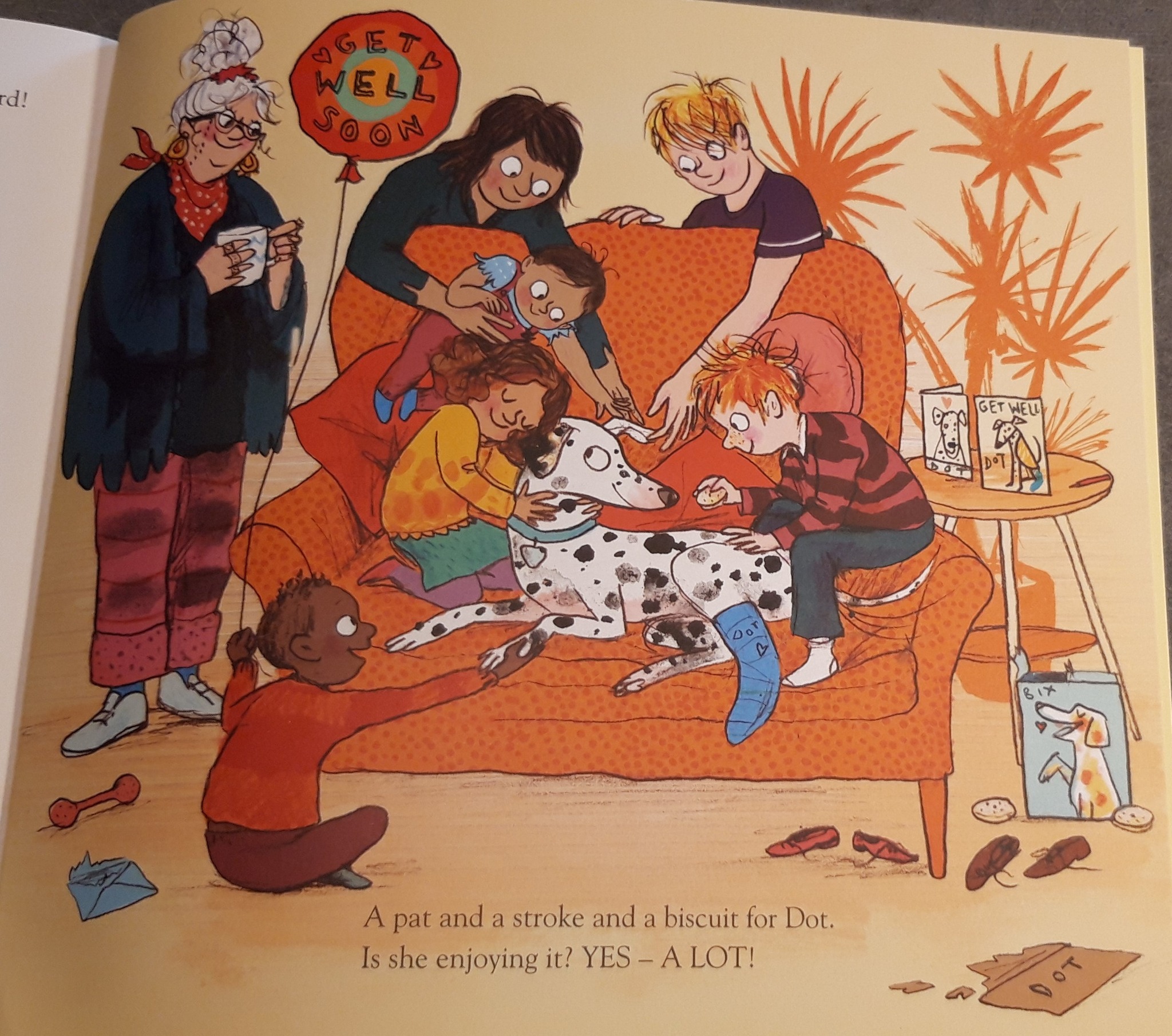
But there is a twist in the story when Dot is knocked over by a car as she is trying to save Joe who is crossing a road, and then becomes a bored patient herself at home with her leg in plaster. Now it’s the children’s turn from the hospital to visit Dot and cheer her up!
The bright humorous inclusive ink drawings are full of life, warmth, expression and synchronise with the rhyming words. We see the children’s facial expressions transform from worried, shy, bored, cross and frowning and unhappy to happy and laughing when Dot visits, and I love the way Sara Ogilvie has captured Dot’s expressions too! There are also lots of details in the illustrations for children to notice and talk about.
The rhyming couplets will help children make predictions and develop their vocabulary as well as encounter extra, more specific vocabulary linked to hospitals and illnesses such as, ward, bed, doctor and, ache, plaster, spots, cough, x-ray and limp. Children could also create their own get-well card for Dot or someone they know who may be in hospital and find out about real therapy dogs. ‘The Hospital Dog’ is a great picturebook for raising children’s awareness about the important role of therapy dogs and about children who have to spend time in hospital.
You can watch Julia Davidson giving a read-aloud and learn how to draw Dot with Sara Ogilvie here https://www.juliadonaldson.co.uk/…/the-hospital-dog/.


Show/Hide Description.
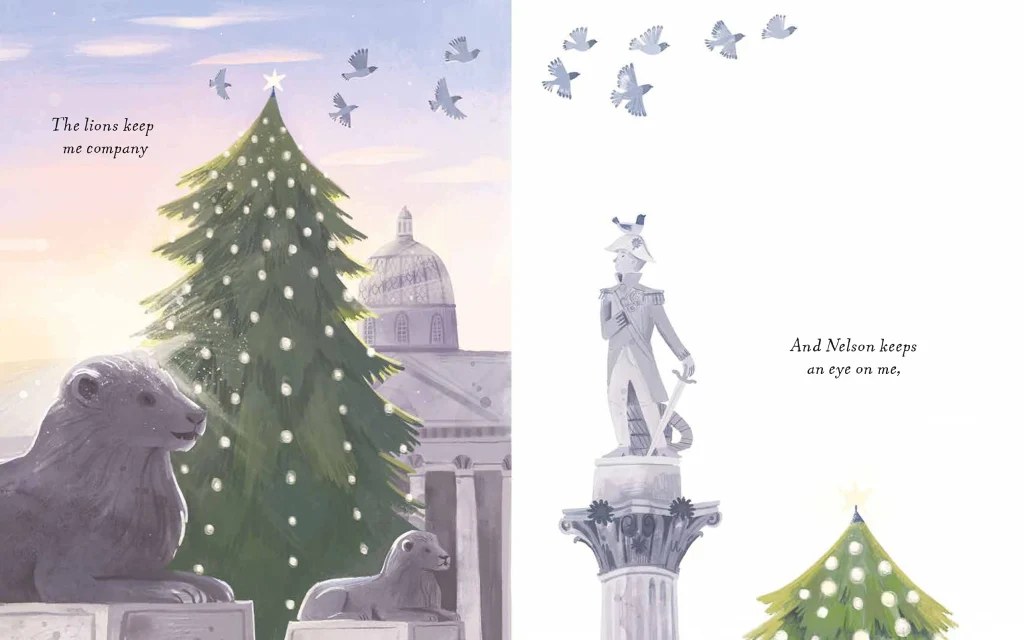
I, (Tatia), continue with this month’s theme of ‘Julia Donaldson-Beyond The Gruffalo’ with ‘The Christmas Pine’ written, of course, by Julia Donaldson, illustrated by Victoria Sandøy and published by Alison Green Books in 2021. I understand that, considering we are in the month of May, this might seem an unconventional choice. However, this picturebook has quickly become one of my favourite Julia Donaldson publications for the opportunities it offers in the primary ELT classroom.
As to be expected, ‘The Christmas Pine’ is written in rhyme, and like Gail’s choice, ‘The Hospital Dog’, this book too is based on a true story that goes as follows: Each year, since 1947, Norway has sent a 20-meter-tall Norway spruce to the people of Britain as a gift for their support during World War II. The tree is cut, shipped, decorated, and erected at Trafalgar Square in London. The tree remains at Trafalgar Square until the 12th day of Christmas (5 January), and this year, 2023, it celebrates its 75th anniversary. During the month of December, this world-famous tree is often used for various activities, such as carol singing. Since 2009, The Poetry Society (UK) has been working with the Royal Norwegian Embassy in London to create a primary-school poetry project inspired by the tree, and every year, it commissions a poet to create a poem to decorate the base of the Trafalgar Square Christmas tree. In 2020, Julia Donaldson was commissioned, and her poem is ‘The Christmas Pine’.
‘The Christmas Pine’ centres on the life and journey of a pine tree that grows up in Norway and, one year, becomes the chosen tree for London’s Trafalgar Square. Donaldson has created a poem that is accessible for children and young language learners: 5 stanzas with 6 (verse) lines each, 5-8 words per line, often with short, one-syllable, and high-frequency words. The illustrations by Norwegian illustrator Sandøy are detailed, colourful, and atmospheric. Her work reflects London’s diversity, and by playing with light, she creates an atmosphere, which perhaps is a nod to her home country, Norway?
What brings the poem to life is that it is narrated in the first person (from the tree’s perspective), so the tree is telling the story. This, in my view, allows the reader to connect with the tree. It also opens up various ELT possibilities. For example, learners could rewrite the poem in the third person. A ‘speaking’ tree, can most certainly fuel imagination. Learners could create short dialogues between the tree and, for example, objects such as the boat shipping it to London or celestial objects such as the stars above its crown at night-time. More advanced learners might write these dialogues in rhyme. Eventually, these dialogues could be put together into a play and performed.
A few of Donaldson’s word choices, such as ‘snow’ or ‘sea’, can be used to encourage learners to find additional rhyming words; other words such as ‘tree’ could be used (for giggles) to create multi-syllable imaginary rhyming words. The last stanza includes lines that shift from past tense to present tense and could offer a steppingstone to focus on the verbs in the poem and tenses:
Remember how I grew and shone,
And may the children grow and shine,
Finally, for teachers looking for links beyond English, there is, of course, the link to biology as the tree grows from seed to tree. Then, on a more philosophical level, discussions could centre on life (people, objects, plants, animals etc), purpose, migration, recycling, new life…
The Poetry Society has created some resources; do have a look, and perhaps this is something to return to in a few months’ time in preparation for this year’s winter festivities!

Show/Hide Description.
The final post for this month on PEPELT, a month that we have all used to talk about Julia Donaldson’s “other” picturebooks, is by Anneta Sadowska. As usual Anneta shares her experience of taking a picturebook into the classroom.
Anneta used ‘The paper dolls’ by Julia Donaldson & Rebecca Cobb (Macmillans Children’s books, 2012). “A string of paper dolls go on a fantastical adventure through the house and out into the garden. They soon escape the clutches of the toy dinosaur and the snapping jaws of the oven-glove crocodile, but then a very real pair of scissors threatens…”
1) The cycle of life and the passing of time
2) The delicate subject of loss
3) Cooperation and collaboration
4) Arts and crafts
5) A language focus
6) Reflecting on the lack of repercussion
Follow this link to discover how ‘The Paper Dolls’ broke a Guinness World Record! https://www.juliadonaldson.co.uk/…/pic…/the-paper-dolls/
Enjoy Anneta’s film … and you still have time to let us know which “other” Julia Donaldson picturebooks you’d recommend before the end of the month 
 Picturebooks in European Primary English Language Teaching